MASINDE MULIRO UNIVERSITY OF SCIENCE & TECHNOLOGY
ECE 422- DATA COMMUNICATIONS & COMPUTER NETWORKS
INTRODUCTION TO T
1.0
INTRODUCTION
Address Resolution Protocol (ARP) is one of the major protocol in the TCP/IP
suit. Its purpose to resolve an IPv4 address (32 bit Logical Address) to the
physical address (48 bit MAC Address).
Network Applications at the Application Layer use IPv4 Address to
communicate with another device.
But at the Datalink layer, the addressing is MAC address (48 bit
Physical Address), and this address is burned into the network card
permanently. You can view your network card’s hardware address by typing the
command "ipconfig /all" at the command prompt (Without double quotes using
Windows Operating Systems).
The purpose of Address Resolution Protocol (ARP) is therefore to find out
the MAC address of a device in your Local Area Network (LAN), for the
corresponding IPv4 address, which network application is trying to
communicate.
The ARP protocol can be broken down to seven steps as follows.
1. When a source device want to communicate with another device, it checks its Address Resolution Protocol (ARP) cache to find it already has a resolved MAC Address of the destination device. If it is there, it will use that MAC Address for communication. To view your Local Address Resolution Protocol (ARP) cache, Open Command Prompt and type command "arp -a" (Without double quotes using Windows Operating Systems).
2. If ARP resolution is not there in local cache, the source machine will generate an Address Resolution Protocol (ARP) request message, it puts its own MAC address as the Sender Hardware Address and its own IPv4 Address as the Sender Protocol Address. It fills the destination IPv4 Address as the Target Protocol Address. The Target Hardware Address is left blank, since the machine is trying to find that.
3. The source device broadcasts the Address Resolution Protocol (ARP) request message to the local network.
4. The message is received by each device on the LAN since it is a broadcast. Each device compare the Target Protocol Address (IPv4 Address of the machine to which the source is trying to communicate) with its own Protocol Address (IPv4 Address). Those who do not match will drop the packet without any action.
5. When the targeted device checks the Target Protocol Address, it will find a match and will generate an Address Resolution Protocol (ARP) reply message. It takes the Sender Hardware Address and the Sender Protocol Address fields from the Address Resolution Protocol (ARP) request message and uses these values for the Targeted Hardware Address and Targeted Protocol Address of the reply message.
7. Destination device send the Address Resolution Protocol (ARP) reply message and it will NOT be a broadcast, but is designated to the sender, i.e it is unicast.
4.3 ARP PACKET FORMAT
The Address Resolution Protocol (ARP) packet is as shown below.
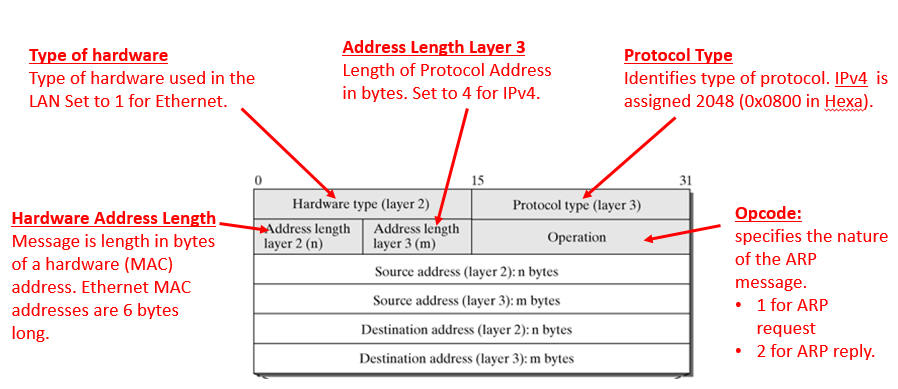
Details of the various components of the packet are discussed below.
Hardware Type: Hardware Type field in the Address Resolution Protocol (ARP) Message specifies the type of hardware used for the local network transmitting the Address Resolution Protocol (ARP) message. The value for Ethernet is 1. The size of this field is 2 bytes.
Protocol Type: Each protocol is assigned a number used in this field. IPv4 is assigned 2048 (0x0800 in Hexa).
Hardware Address Length: Hardware Address Length in the Address Resolution Protocol (ARP) Message is length in bytes of a hardware (MAC) address. Ethernet MAC addresses are 6 bytes long.
Protocol Address Length: Length in bytes of a logical address (IPv4 Address). IPv4 addresses are 4 bytes long.
Sender Hardware Address: Layer 2 (MAC Address) address of the device sending the message.
Sender Protocol Address: The protocol address (IPv4 address) of the device sending the message
Target Hardware Address: Layer 2 (MAC Address) of the intended receiver. This field is ignored in requests.
Target Protocol Address: The protocol address (IPv4 Address) of the intended receiver.
Online References